


















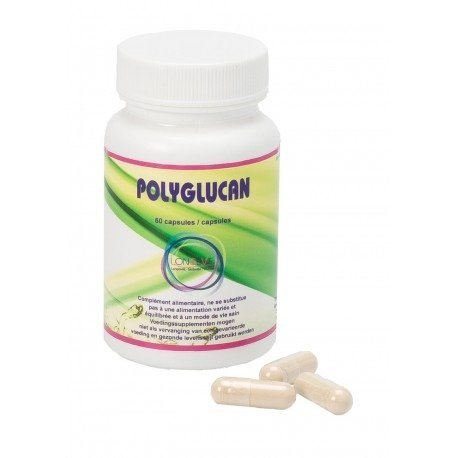

Polyglucan is any polysaccharide that contains glucan units. Specifically, polyglucan’s are a structural polysaccharide. The basic polyglucan unit consists of a long linear chain of several hundred to many thousands D-glucose monomers attached with a type of covalent bond called, glycosidic bonds. The point of attachment is O-glycosidic bonds, where a glycosidic oxygen links the glycoside to the reducing end sugar. Polyglucans naturally occur in the cell walls of bacteria. Bacteria produce this polysaccharide in a cluster near the bacteria’s cells. Polyglucan’s are a source of beta-glucans. Structurally, beta 1.3-glucans are complex glucose homopolymers binding together in a beta-1,3 configuration Polyglucans are utilized as a carbon source for microbial fermentation. Although polyglucan production has so far been promoted by nutrient limitation, it must be further enhanced to accommodate market demand. The combined strategies of cultivation design and genetic engineering are used for polyglucan productivity for bioethanol production.[3] Polyglucans are also involved in another sector of the energy industry, acting as biopolymers to increase oil recovery. The polysaccharide is attached to the bacteria cells and then mixed in an alkali solution such as sodium hydroxide to become soluble. After which, it is then pumped into the injection well. The reason it needs to be a fluid is so you can pump the polysaccharides into the reservoir, but then the polysaccharide needs to gel/solidify/precipitate in situ upon addition of another chemical in order to plug up the pore. The biopolymer is then combined and injected with water until it fills up at least 30% of the empty pores. Next, there is an injection of an acid solution or CO2 forming HCO3. This neutralizes the solution and allows for the precipitation of the biopolymer, polyglucans, inside the high-permeability zones. Evidence shows that the application of this polyglucan can reduce the permeability of approximately 80% of the high-permeability zones.[4] Oil companies are able to benefit from the decreased permeability because oil tends to flow in areas with the highest permeability. They can also serve as dietary supplements.
Shipping & Delivery – Equines Meds
At Equines Meds, we understand that timely delivery is essential when it comes to caring for your animals. That’s why we provide fast, reliable, and worldwide shipping on all veterinary medicines and supplements.
🌍 Global Reach: We proudly ship to Australia, Germany, and many other countries across Europe, Asia, Africa, and the Americas.
🚚 Trusted Delivery: Every order is carefully packaged and dispatched with leading courier partners to ensure safe arrival.
⏱️ Efficient Service: Most orders are processed within 24–48 hours, so your animals get the care they need without delay.
🐴 Specialized Products: Our catalog focuses on horse medicines, while also offering trusted treatments for camels, livestock, poultry, and companion animals. And we also provide prescriptions as well.
Why Choose Equines Meds for Shipping?
Transparent shipping policies with clear tracking updates.
Competitive international delivery rates.
Dedicated customer support for any shipping inquiries.
At Equines Meds, our mission is to make veterinary medicines accessible worldwide with speed, reliability, and professionalism. Whether you’re ordering horse supplements in Australia or livestock treatments in Germany, you can count on us to deliver with care.



Reviews
There are no reviews yet.